Where Can I Find Solved IGNOU Question Papers?
You can find solved IGNOU question papers through specialized educational support portals, academic publishers, digital study repositories, and mobile apps. While the official Indira Gandhi National Open University (IGNOU) portal and eGyanKosh provide unsolved previous year question papers (PYQs) for free, students seeking complete, step-by-step answered solutions and model exam keys rely on dedicated student platforms and guidebooks.
Top Sources for IGNOU Solved Question Papers
Finding the right solved question paper depends on whether you are looking for free reference keys, complete downloadable PDFs, or physical reference books.
-
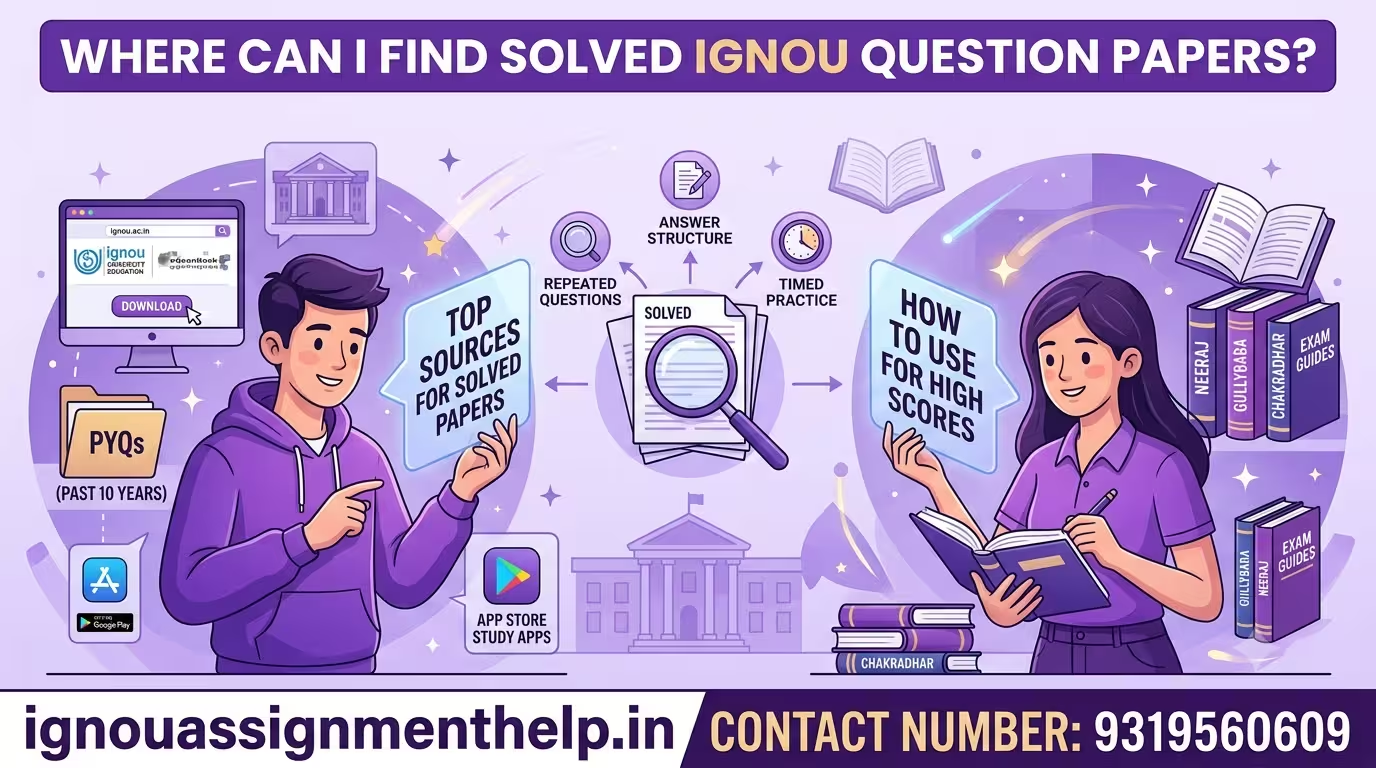
Academic Study Support Websites: Specialized educational platforms offer downloadable PDFs of solved question papers, model answer keys, and guess papers for almost every course code across BA, BCom, BSc, MA, MCom, MBA, and MCA.
-
Official University Portal & eGyanKosh (Unsolved Base Papers): The official IGNOU website publishes unsolved question papers from the past 10 years (June and December Term-End Exams). Studying these alongside course blocks allows you to prepare your own comprehensive solutions.
-
Publisher Reference Books & Exam Guides: Published guidebooks (such as Neeraj, Gullybaba, and Chakradhar) compile 5 to 10 years of solved TEE question papers categorized by unit and subject code.
-
IGNOU Mobile Apps & Digital Repositories: Several educational apps on Google Play Store offer subject-wise previous year question papers paired with expert-written solutions for quick mobile study.
Comparison: Official Portal vs. Solved Paper Providers
| Source Category | Content Available | Best Used For | Format |
| Official IGNOU Portal | Unsolved Question Papers (Past 10 Years) | Checking official paper pattern, mark distribution, & unit weightage | Free PDF |
| Educational Support Portals | Complete Solved PYQs, Model Solutions, & Guess Papers | Fast exam revision, understanding answer structure, & last-minute prep | Downloadable PDF / Online |
| Publisher Reference Books | Chapter-wise Solved PYQs & Important Question Banks | In-depth topic revision and comprehensive subject understanding | Physical Book / E-Book |
| Student Mobile Apps | Session-wise Question Papers & Worked Solutions | Practice on-the-go and quick reference during travel | Mobile Application |
How to Use Solved Question Papers for High Exam Scores
Simply reading through solved question papers is not enough to secure top grades in IGNOU Term-End Examinations (TEE). Follow these four steps to maximize your performance:
-
Identify Repeated Questions: Download question papers from the last 3 to 5 years (both June and December TEE sessions). Compare them to identify core concepts and questions that appear repeatedly.
-
Understand the Answer Structure: Use solved answer keys to learn how to structure 20-mark, 10-mark, and 5-mark responses. Focus on intro-body-conclusion layouts, bullet points, and diagram placement.
-
Write Answers in Your Own Words: Never memorize solved papers word-for-word. Rephrase the solutions in your own handwriting during revision to build speed and retain concepts better for exam day.
-
Time Your Practice Sessions: Pick an unsolved or solved question paper, set a timer for 3 hours, and practice writing the complete paper under real exam conditions to manage your time effectively.
Checklist Before Downloading or Buying Solved Papers
To ensure you are studying the correct and updated material, verify these details before using any solved paper:
-
Session & Course Code Accuracy: Double-check that the course code matches your current syllabus (e.g., CBCS course codes like BEVAE-181, BCOS-183, MMPC-001).
-
Syllabus Revision Check: Ensure the solved answers follow the latest revised syllabus issued by IGNOU for the current academic year.
-
Word Count & Clarity: Verify that the answers adhere to the word limits specified in actual TEE question papers (500 words for long questions, 250 words for medium questions, and 100 words for short notes).